

You cross the marathon finish line feeling proud, exhausted, and ready for a break. A few days later, the soreness starts to fade—but that familiar tight calf or nagging hip discomfort is still hanging around.
Sound familiar?
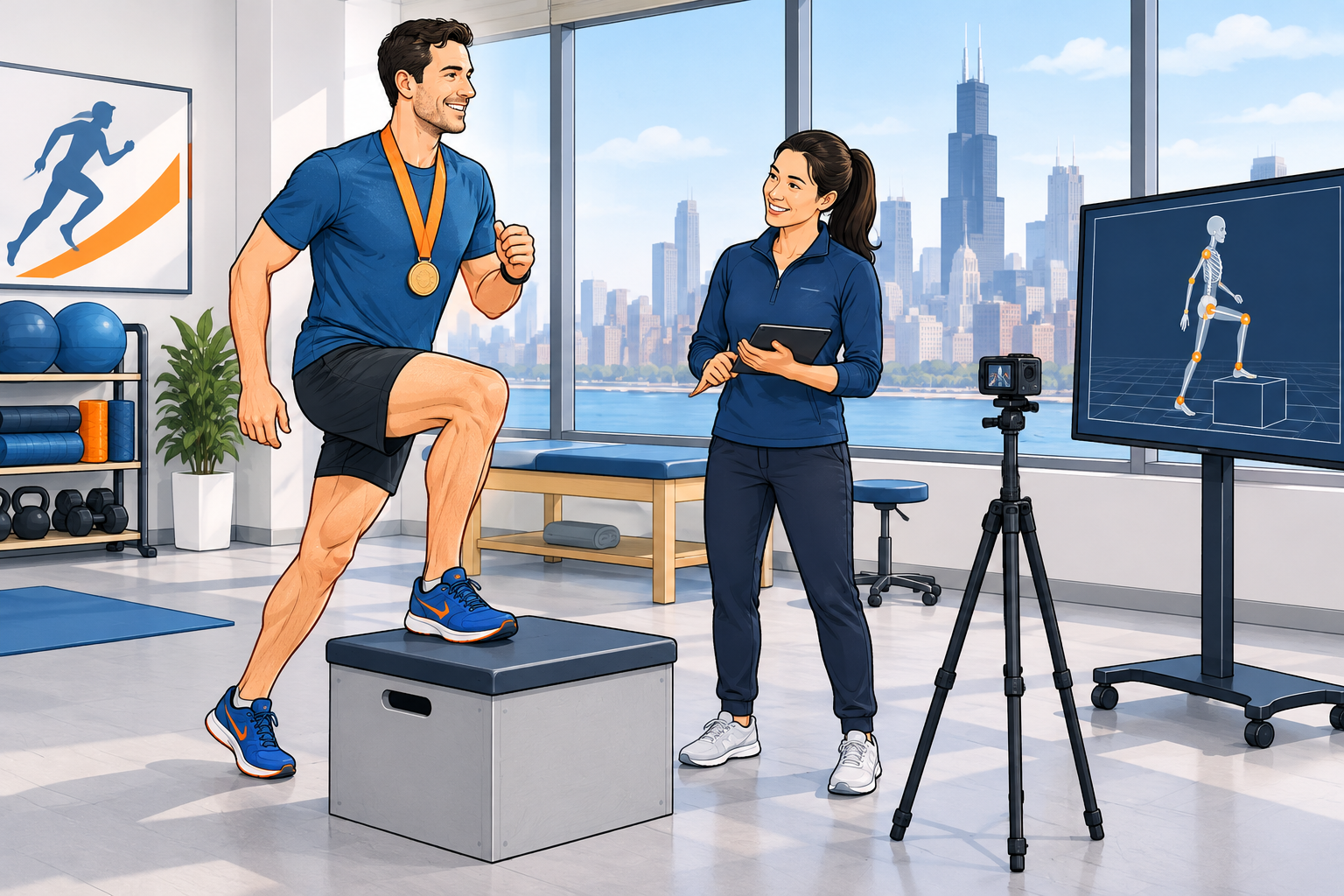
Functional training for runners gives you a chance to address those concerns once you’ve recovered from the race. Instead of jumping straight into the next training cycle, you can use the offseason to build strength, improve movement, and take a closer look at the issues that showed up along the way.
At Chicago Spine and Sports, we also use 3D motion capture to dig deeper into how you move—so your training plan can be based on more than guesswork.
💡 Quick answer: After a marathon, functional training can help runners rebuild strength, balance, and movement control once they’ve recovered. An individualized movement assessment, including 3D motion capture when appropriate, can help guide the plan.
What Is Functional Training for Runners?
Functional training focuses on movements and abilities that support the activities you want to do. For runners, that often means building strength, balance, mobility, and control for the repeated demands of running.
Think about what happens with every stride: you land on one leg, support your body weight, move forward, and repeat. Your feet, ankles, knees, hips, and trunk all play a part.
Functional training can include exercises such as:
Single-leg strength work
Squats, step-ups, and lunges
Calf and foot strengthening
Hip and trunk exercises
Balance and controlled movement drills
The goal isn’t to make every runner move identically. It’s to help you build the capacity and control that make sense for your body and your goals.
Why Is the Offseason a Good Time to Work on Running Mechanics?
During marathon training, your schedule can revolve around long runs, speed work, and getting enough recovery between them. That doesn’t always leave much room to investigate a recurring issue or prioritize strength training.
Once you’ve allowed yourself time to recover, the offseason offers an opportunity to ask:
Did the same area become uncomfortable as my mileage increased?
Did I notice a difference between my left and right sides?
Did hills, speed work, or long runs bring on symptoms?
Did an old injury return during training?
Was I able to consistently fit in strength work?
The answers can help guide what to assess and where to focus. A movement difference isn’t automatically a problem, and pain can have more than one contributing factor—including training load, recovery, and previous injuries.
First, Give Your Body Time to Recover
Before you start a new strength program, take time to recover from the marathon itself.
Recovery varies depending on your training, how hard you raced, and how you feel afterward. UCLA Health recommends taking a few days off from running, using comfortable, low-intensity activity as tolerated, and returning with shorter, easier runs before gradually increasing distance and speed. Sleep, food, and fluids matter, too. [1]
Once ordinary movement feels comfortable and your post-race soreness has settled, you can begin rebuilding gradually. If you have persistent or worsening pain, don’t assume you simply need to train through it.
How Can 3D Motion Capture Help Runners?
Sometimes a runner knows where something hurts but not what may be contributing to it. That’s where a closer movement assessment can be useful.
At Chicago Spine and Sports, we use Kinetisense markerless 3D motion capture to measure aspects of movement, range of motion, and functional performance. Depending on your assessment, we may look at movements such as a squat, lunge, or single-leg balance.
For example, the assessment may help us explore:
How your hips, knees, and ankles move during a task
Whether one side moves differently from the other
How you control a single-leg movement
Whether a mobility limitation is worth investigating further
The technology gives us another way to measure and reassess movement. It doesn’t diagnose an injury on its own or mean every difference needs correcting. We interpret the findings alongside your history, symptoms, examination, and training goals.
From there, we can identify which findings are relevant and build a plan around them.
Functional Training Exercises for Runners
Your best starting point depends on your experience, recovery, and any symptoms you’re experiencing. These are examples of movement patterns that may be included in an offseason plan—not a one-size-fits-all prescription.
1. Step-Ups
Step onto a low, stable platform, then lower yourself with control. Step-ups are a practical way to work on single-leg strength and control.
Start simply: Use a low step and hold a railing or wall for balance if needed.
2. Split Squats
Stand in a staggered stance and bend both knees to lower and rise under control. This movement challenges each leg while allowing you to adjust the depth to your comfort.
Start simply: Use body weight and a comfortable range of motion.
3. Calf Raises
Rise onto the balls of your feet, then lower slowly. Calf raises can build strength in the muscles that help you push off with each stride.
Start simply: Begin with both feet and use a counter for support. A single-leg version may be an option as you get stronger.
4. Single-Leg Balance
Stand on one leg with a soft knee and aim to stay steady. Balance work can help you practice control in the supporting leg.
Start simply: Stand near a wall or countertop. Once that feels manageable, your clinician may suggest a more challenging variation.
5. Hip Hinge
Push your hips back as if closing a car door behind you, then stand tall. This movement helps you practice using the muscles around your hips while maintaining control through your trunk.
Start simply: Use body weight before adding resistance.
Choose exercises you can perform with control, and build gradually. If an exercise causes sharp or increasing pain, stop and have it assessed.
Can Strength Training Improve Running Performance?
It can help. A 2024 systematic review found that certain strength-training approaches, including heavier resistance training, improved performance measures in middle- and long-distance runners. The certainty of the evidence ranged from very low to moderate, and the right starting point still depends on the individual. [2]
That doesn’t mean you need to start lifting heavy weights immediately after your marathon. Begin at a level that fits your experience and recovery, then progress over time.
It’s also important to keep expectations realistic: no exercise program can guarantee you won’t get injured. A review of exercise-based prevention programs found no overall reduction in running-related injury risk, although a smaller analysis of supervised programs showed more promising results. [3]
-
Start with recovery. Once your soreness has settled and you’re moving comfortably, you can gradually reintroduce light exercise. The timing will vary, especially if you’re managing an injury or had a particularly difficult race.
-
Not necessarily. Many runners enjoy keeping some easy running in their routine. The key is to match your running and strength work to your recovery, symptoms, and next goal.
-
No single test can do that for everyone. Motion capture can provide useful measurements, but those findings need to be considered alongside your symptoms, training history, and clinical examination.
-
You don’t have to be injured to benefit from a thoughtful strength and movement program. The offseason can be a useful time to build capacity and prepare for your next training cycle.
Ready to Build a Stronger Foundation for Your Next Race?
Your marathon may be over, but the offseason is a chance to put what you learned in training to work.
If you’re dealing with a recurring running issue—or you’d like a clearer picture of how you move—Chicago Spine and Sports can help you assess your movement and develop an individualized plan.
Call our Chicago office at 773-529-0057 or schedule an appointment to get started.
